Why a fast connection can still feel slow.
Download speed gets the headlines. For phone calls, video meetings, VPNs and cloud apps, latency matters just as much. Latency is the delay on every trip your data takes. Here's how OpenTier fixed wireless compares with satellite internet such as Starlink, in plain language.
Speed is how much. Latency is how long.
Picture a TV news anchor talking to a reporter overseas. Both can hear each other perfectly, but every answer arrives a beat late, so they pause awkwardly or talk over each other. That beat is latency. The connection can be crystal clear and still feel awkward.
Speed (bandwidth)
How much data can arrive each second, measured in Mbps (megabits per second). Think of it as how many lanes a highway has.
Latency
How long one round trip takes, from your computer to a server and back, measured in ms (milliseconds, thousandths of a second). Think of it as how far away the destination is.
Jitter
How much that delay changes from moment to moment. A steady delay is easy for apps to handle. A delay that keeps jumping around causes stutters and dropouts.
One stays on the ground. The other goes to space and back.
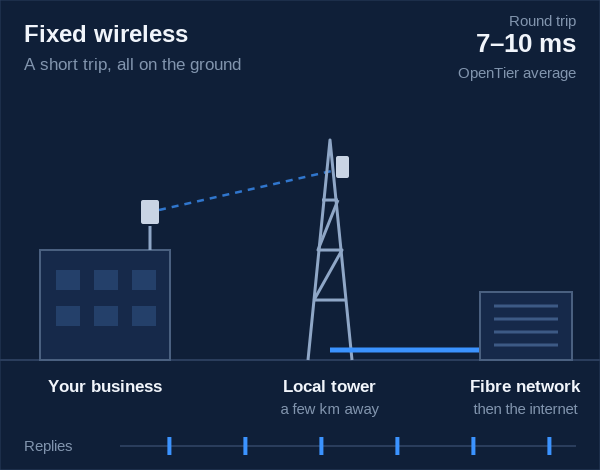
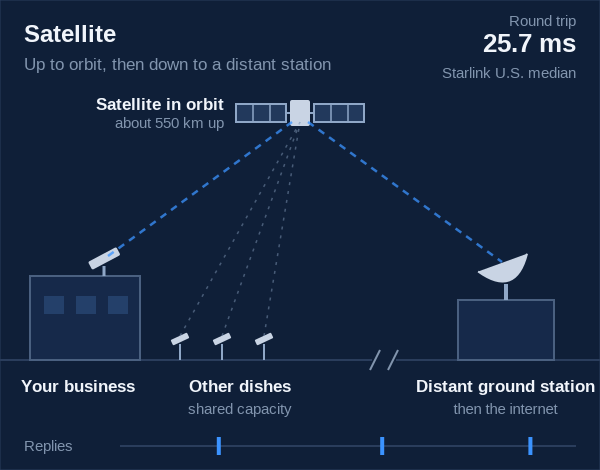
OpenTier fixed wireless
Your rooftop radio talks to one of our towers a few kilometres away. The tower connects straight into our fibre network, which has more than one carrier connection. The whole trip stays on the ground and close to home, so the delay is short and steady.
Satellite internet
Your dish sends the signal about 550 km up to a satellite moving across the sky. The satellite relays it down to a ground station, which can be far from you, before it reaches the internet. The dish hands off from one satellite to the next as they pass overhead, and everyone under the same satellite shares its capacity. So the delay can change through the day: at busy times, in heavy rain or snow, or when trees and buildings block part of the sky.
Typical round-trip delay
Lower is better. These are typical figures, not guarantees. Your own results depend on your location, equipment and the apps you use.
Independent tests run higher than Starlink's own figure. Ookla, the company behind Speedtest, found Starlink's median latency under 40 ms in 24 U.S. states and Washington, D.C. in the first half of 2026, and higher in some places, such as 84 ms in Alaska [3]. Starlink and Ookla measure in different ways, so their numbers aren't directly comparable.
Real-time apps feel every millisecond.
Streaming a video can buffer ahead, so delay hardly matters. These apps can't wait. They need a quick, steady reply every time.
Phone calls (VoIP)
Internet phone systems send your voice in small pieces many times a second. Long or uneven delay leads to talking over each other, echo or choppy audio.
Teams and Zoom
Video meetings keep sound and picture in sync in both directions, while also uploading your own camera feed.
VPN to head office
A VPN is a secure tunnel to your company network. Opening a shared file can take many round trips, so even small delays add up.
Point of sale
Each card payment or stock lookup waits for a reply from a server. A short, steady delay keeps the line moving.
Remote desktop
Every click and keystroke travels to a computer somewhere else and back before you see it happen on screen.
Cloud apps
Accounting, CRM and file-sync tools make lots of small requests. Lower delay makes them feel snappier.
Upload and busy hours matter too.
Upload is how fast you can send data out: your side of a video call, cloud backups, large files to clients, security cameras. Our Business 100/50 plan includes 50 Mbps of upload, and higher speeds are quoted for you. For comparison, Ookla measured Starlink's U.S. median upload at 20.73 Mbps in the first half of 2026 [3]. A plan speed and a measured median aren't the same thing, so treat this as a rough guide.
Busy hours are when everyone is online at once. Satellite capacity is shared by everyone under the same satellite, so speed and delay can change through the day. With OpenTier, the link from your roof to our tower is planned for your site during the free site survey, and our towers feed straight into our fibre network.
| Task | OpenTier fixed wireless | Satellite |
|---|---|---|
| Phone calls | Natural back-and-forth | Usually clear, with the odd brief dropout or overlap |
| VPN | Close to being in the office | Fine for most work; delay adds up on chatty apps |
| Video meetings | Steady picture and sound | Generally good; can freeze for a moment when the delay jumps |
| Large uploads | 50 Mbps upload on Business 100/50 | Ookla U.S. median 20.73 Mbps [3] |
General expectations, not measurements of your connection.
When satellite is the right choice.
Satellite internet has changed rural connectivity for the better. Where no fixed wireless, cable or fibre reaches, a service like Starlink is a solid option, and far better than the older satellite services that orbit much higher up. It also makes a useful backup line. If we reach your address, though, a local ground connection will give you a shorter, steadier delay and more upload.
Sources
- OpenTier: average latency on our fixed wireless network, 7–10 ms.
- Starlink, Network Update (July 2025): median peak-hour latency of 25.7 ms across U.S. customers as of June 2025.
- Ookla, Starlink's U.S. Speeds Rise Amid SpaceX IPO (November 11, 2026): Speedtest data for the first half of 2026.
Figures checked November 2026. Satellite figures change as networks add capacity.
See if OpenTier reaches you.
Enter your address to check coverage. If we reach you, we'll book a free site survey. No obligation.